Building a Collaborative Ecosystem for AI in Health: 2026 BERD Forum Highlights
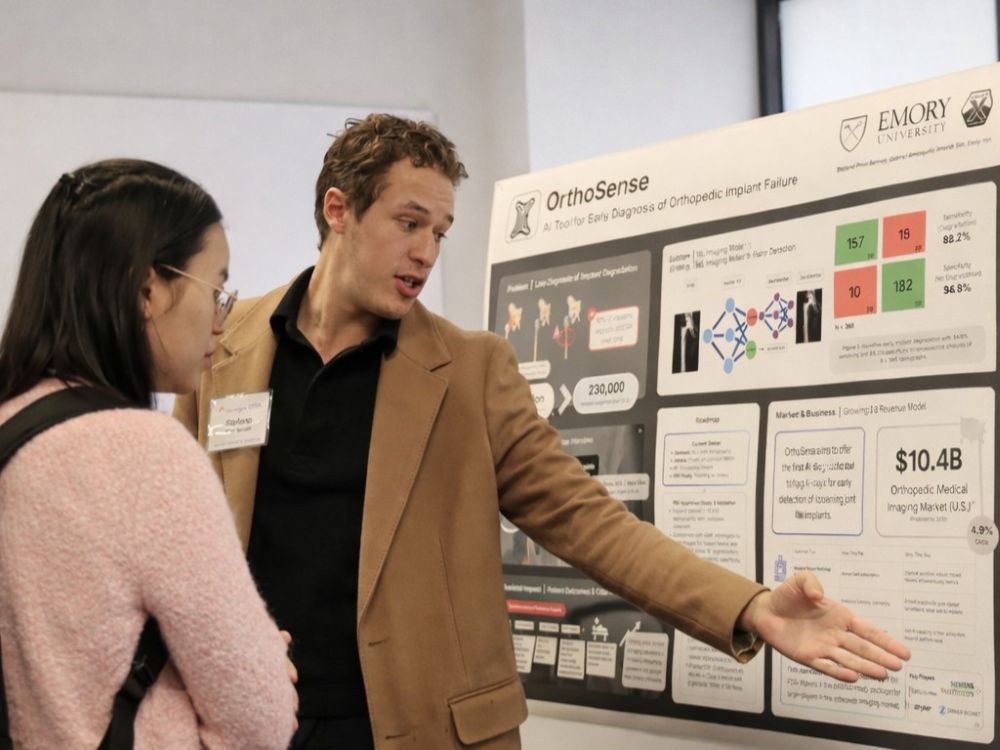
The 2026 Georgia CTSA Biostatistics, Epidemiology, and Research Design (BERD) Forum brought together researchers, faculty, trainees, and industry professionals to explore the evolving role of artificial intelligence in medical and health care systems. Hosted at Georgia Tech's School of ISyE and co-sponsored by the Center for Health and Humanitarian Systems, this year’s forum focused on advancing AI methodologies while strengthening their translation into real-world settings.
Growing Reach and Collaboration
The 2026 BERD Forum marked the largest gathering in the event’s recent history. Attendance grew from 40 participants in 2023 to 48 in 2025, and more than doubled in 2026 with 111 attendees. The strong growth reflects expanding interest in advanced analytic methods and AI-driven innovation across Georgia’s clinical and translational research community. This upward trend also mirrors the continued growth and visibility of the Georgia CTSA BERD Program, as more investigators seek methodological expertise and collaborative support to strengthen their research.
Participants represented Georgia Tech, Emory University, Morehouse School of Medicine, University of Georgia, and additional collaborating institutions across the Southeast, including the keynote speaker from the University of North Carolina. The forum also welcomed engagement from potential collaborators across academia and the pharmaceutical industry, reinforcing its role as a cross-institutional and cross-sector platform for meaningful scientific exchange.
Georgia CTSA BERD Co-Director Xiaoming Huo, PhD, forum organizer and faculty member at Georgia Tech, emphasized the significance of this meeting:
“The ‘Artificial Intelligence in Medical and Health Care Systems’ forum represents a vital convergence of disciplines, bringing together leading minds from Georgia Tech, Emory, MSM, and UGA. By bridging the gap between advanced AI methodology and real-world clinical application, we are not just sharing research — we are building a collaborative ecosystem. This event has highlighted how interdisciplinary perspectives can transform AI from a predictive tool into a trustworthy, causal framework that can truly enhance patient outcomes. The energy and new ideas sparked here will undoubtedly drive the next generation of medical and health care innovation.”
Advancing AI Through Methodological Rigor
The program featured presentations that spanned foundational statistical methodology and applied health research. Topics included causal AI frameworks for clinical decision-making, interpretable machine learning approaches in health systems research, predictive modeling for infectious disease elimination, and AI-enabled strategies in neuroimaging and spatial transcriptomics.
Across sessions, speakers underscored the importance of transparency, interpretability, and rigorous statistical foundations in developing AI systems that can responsibly translate into practice. The discussions emphasized moving beyond purely predictive models toward causal, trustworthy frameworks that support meaningful and sustainable clinical impact.
Showcasing Innovative AI-driven Research
A competitive student poster session showcased innovative quantitative and AI-driven research from emerging scholars across the state. The competition provided trainees with an opportunity to present their work, engage with senior investigators, and receive feedback from a multidisciplinary audience.
Poster Award Winners:
- 1st Place, Yuming Sun, Georgia Tech ISyE
Improved Operations of Infectious Disease Elimination: A Model-Based Study of Polio
- 2nd Place, John Ofem, Kennesaw State University
AI-Powered Drug-Drug Interaction Analysis System Using RAG With FDA-Verified Evidence
- 3rd Place, Haoran Lu, University of Georgia
Optimal Gene Panel Selection for Targeted Spatial Transcriptomics Experiments
The poster competition highlighted the next generation of researchers applying advanced modeling techniques to address complex biomedical and public health challenges.
Fostering Meaningful Partnerships
Strong engagement was reflected in post-event feedback, with 95% of respondents indicating they were likely or extremely likely to recommend the forum to colleagues. One attendee described the event as “a great opportunity for researchers interested in this topic in this region,” while another emphasized the opportunity to connect with “potential collaborators from academia and the pharmaceutical industry.” These reflections underscore the forum’s growing role as a collaborative environment for advancing analytic innovation and fostering meaningful partnerships.
About the Georgia CTSA BERD Program
The continued growth of the BERD Forum reflects the broader mission of the Georgia CTSA Biostatistics, Epidemiology, and Research Design (BERD) Program — to strengthen the methodological foundation of clinical and translational research across Georgia. The BERD Program provides investigators with expert consultation and collaboration in study design, data analysis, clinical trials methodology, and advanced quantitative approaches, supporting projects from early pilot studies to large-scale funded research. Through individualized consultations, educational programming, and events such as the annual BERD Forum, BERD fosters cross-institutional collaboration and promotes rigorous, innovative research.
Learn more about BERD services and resources.