Georgia Health Landscape Offers a Scalable Model for Community-Aligned Translational Research
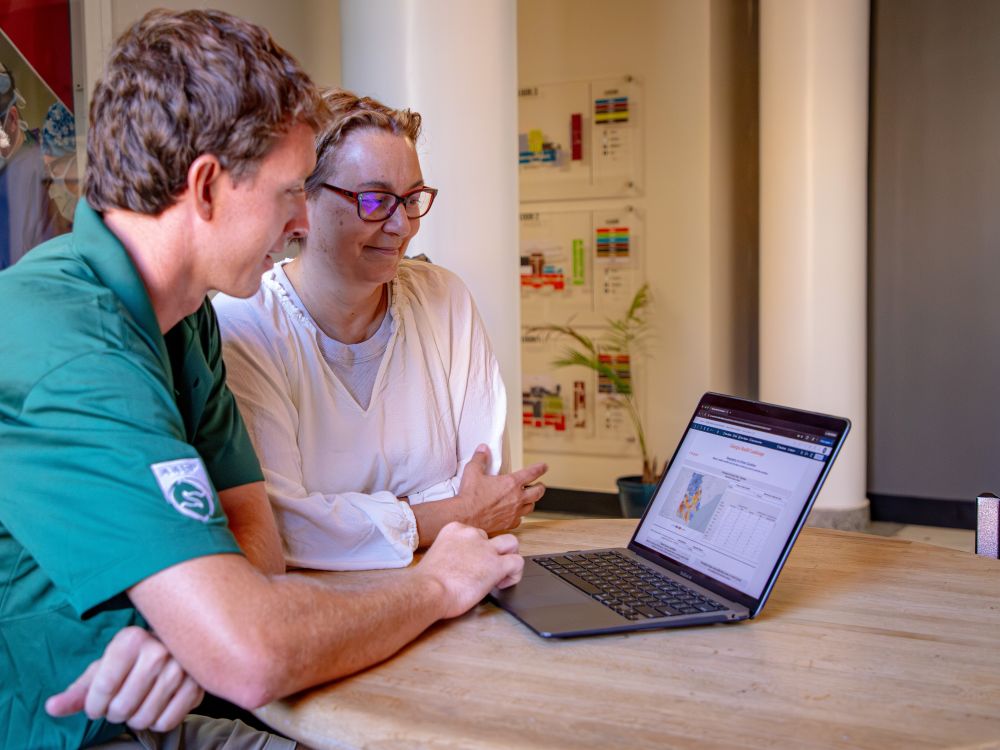
Successful translational research depends on more than a strong scientific question. It also requires the right setting, trusted partnerships, aligned priorities, and a clear understanding of the communities the research is intended to benefit.
To support that work, Georgia CTSA developed the Georgia Health Landscape, a data-informed platform designed to strengthen connections between researchers, programs, innovators, and communities across Georgia. The dashboard brings together public health, demographic, health care, and community-based data to help researchers better understand county-level health needs, community priorities, and opportunities for partnership. Importantly, the platform also incorporates Community Voice, insight derived from resident surveys and community leadership, to provide context that is not captured in traditional data sources. This approach reflects the NCATS Translational Science Principle of utilizing boundary-crossing partnerships that engage communities in research to advance translational progress.
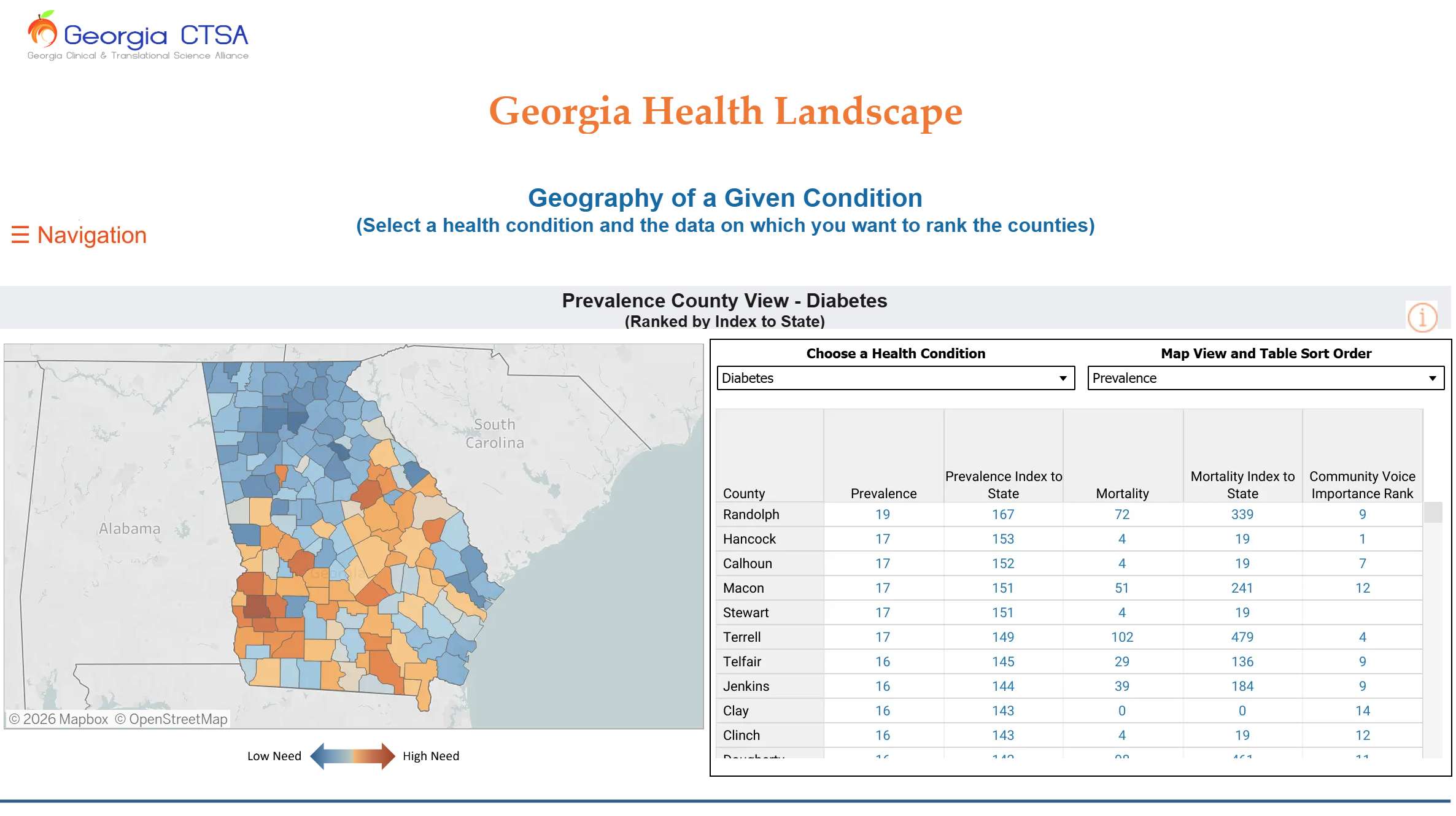
The Georgia Health Landscape consolidates data from sources like the Centers for Disease Control and Prevention, National Cancer Institute, U.S. census, hospitals and other health care providers. It also incorporates community priorities and partnership opportunities gleaned from resident surveys and discussions with local leadership.
“We generate an enormous amount of health data, but it is rarely organized in a way that helps researchers make practical decisions about where and how to engage communities. The Georgia Health Landscape brings those data together into a usable framework that supports more intentional, community-aligned research partnerships,” said Dee Warmath, PhD, MPH, Community Health Engagement, UGA.
The platform grew out of Georgia CTSA efforts that began in 2017, when research faculty sought to engage more people across the state in clinical and translational studies. Early work relied on the expertise of community-engaged partners who worked directly with communities to identify potential matches between research opportunities and local needs. As this work expanded, Georgia CTSA recognized the need for a more structured and scalable process that could broaden the number of candidate communities, support best practices, and guide more informed decisions about research setting selection.
Built over a two-year period, the dashboard consolidates data from public health surveillance sources, including the CDC and National Cancer Institute, Census data, hospital and provider data, and internal UGA Cooperative Extension resources. By bringing these data together in one platform, Georgia Health Landscape helps researchers move from broad assumptions about community needs to more targeted, data-informed planning.
“The tool allows us to bring both data and lived community context into the recommendation process. Instead of relying on a limited set of known locations, we can systematically identify communities where research priorities and local needs are more closely aligned, which leads to stronger partnerships from the start,” said Courtney Brown, PhD, Community Health Engagement Coordinator, UGA.
For researchers, the dashboard offers a practical way to incorporate community intelligence into the research process. Gathering and interpreting community-level data can be time-consuming, and many biomedical researchers may not have the training or resources to identify the most appropriate community settings for their studies. Georgia Health Landscape helps streamline this process by turning multiple sources of information into actionable insight for study planning, partnership development, recruitment strategy, and implementation.
The potential impact extends beyond individual studies. By helping investigators identify communities where research questions and local priorities intersect, Georgia Health Landscape can support stronger engagement, improve recruitment and retention, and foster partnerships built on shared goals. In doing so, the platform helps advance one of the central aims of translational science: ensuring that research is relevant, accessible, and positioned to improve health outcomes.
“The Georgia Health Landscape offers a scalable model for CTSA hubs by combining standardized health data with structured Community Voice. Other hubs could adapt this approach to better align research with community priorities in their own regions while maintaining a consistent framework for decision-making,” said Bradley G. Phillips, PharmD, Principal Investigator, UGA.
The platform demonstrates how hubs can combine data infrastructure, community expertise, and cross-institutional collaboration to create a more intentional approach to matching research with community priorities. As CTSA hubs continue to focus on reach, relevance, and real-world impact, Georgia Health Landscape provides a replicable example of how data and community insight can work together to strengthen translational research across all CTSAs.
Through the Georgia Health Landscape, Georgia CTSA is helping researchers ask not only where a study can be conducted, but where it can make the most meaningful difference.
To learn more about the Georgia Health Landscape, watch the Overview Video.
To access the Georgia Health Landscape for your research, email Dee Warmath.