Georgia CTSA's AppHatchery Shares Innovation Model with International Research Software Community
Promising discoveries in health research often never reach patients. One reason is a missing link between the lab and the people the research is meant to help. Increasingly, that link is software: apps that support patients between visits, tools that help clinicians make decisions, and platforms that accelerate research and improve data quality. The people who build this software are called Research Software Engineers (RSEs). Many of them, including the team at the Georgia CTSA, worked in this field for years before learning that the profession had a name.
The AppHatchery, led by Co-Director Santiago Arconada Alvarez, MS, Emory, works with Georgia researchers and clinicians to turn ideas into patient-facing apps, clinical tools, and research platforms. In six years, the team has grown from two people to eighteen, released 18 software products, and reached more than 50,000 patients and providers.
Driving Innovation Through NIH Support
Earlier this year, Arconada Alvarez received the NIH’s R50 Research Software Engineer Award for his project, “A Foot in Each World: Bridging the Divide Between Clinical Research and the Mobile Apps That Support It.” The award gives research software engineers a funded role in science that does not depend on a single project or investigator. It also gives him three years of dedicated time to deepen his expertise at the intersection of software and clinical research, with a focus on digital tools for diagnosing and treating mental health conditions.
Read Georgia CTSA’s June 2026 spotlight to learn more about his R50 award.
Showcasing AppHatchery’s Model
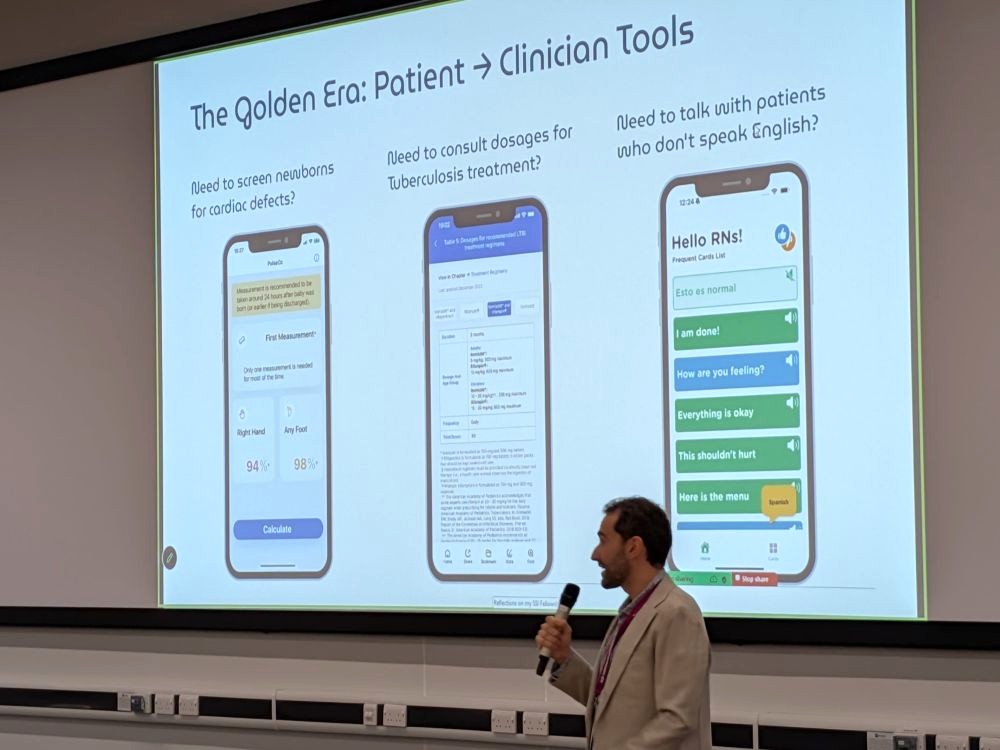
In September, Arconada Alvarez was selected to present at the 2026 International Research Software Engineering Conference (RSECon26) in Sheffield, UK. The conference brought together RSEs from around the world under two themes: RSEs as part of the research journey, and enhancing credit and reproducibility.
His thirty-minute talk, “AppHatchery: From Service Team to Research Partner,” told the story of how the team learned, often the hard way, which software solutions make a meaningful difference in health. Some early apps performed well in studies and received positive feedback from patients but went unused after launch because they were not aligned with needs of the clinic or institution. Over time, the team learned to prioritize projects with committed clinical partners and to develop tools that clinicians and health systems endorse and adopt in everyday practice.
Examples include TypeU, which supports families of children newly diagnosed with Type 1 diabetes; the Georgia TB Reference Guide, which replaced the Georgia Department of Public Health’s paper materials; Vocalis, a digital interpreter being deployed at local hospitals; and Ready for Tonsillectomy, which is now licensed by Texas Children’s Hospital.
The team also builds tools to support the research process itself. Fabla began as a one-off app for a psilocybin trial, the OPTIMIZE study, that needed participants to record diaries several times a day. In a validation study, voice diaries produced richer data than written diaries and were preferred by participants. When other investigators expressed interest in using the app, the team rebuilt Fabla as an open-source platform that any study can configure. Since then, it has supported more than $20 million in funded research.
Conversations following the talk made one thing clear: the AppHatchery’s approach is unusual, even among RSE groups. Many teams focus on building and maintaining software. The AppHatchery takes ideas from their earliest stages and works with clinical partners until the resulting tools are embedded into the health systems and adopted in practice.
“We operate more like a startup than a typical software team,” says Arconada Alvarez. “We don’t stop at a working product. We work with our clinical partners until the tool becomes part of how care or research actually happens. It’s a lot more work, but that’s where the impact is.”
Learning From Research Software Engineering Leaders
Arconada Alvarez also came to RSECon26 to learn from others. He met RSEs whose work ranges from high-performance computing systems to apps like those developed by the AppHatchery. He heard from leaders of established groups about their organizational structures, funding models, and approaches to planning hires around expected grant income. He also learned how some groups create career paths that help retain experienced engineers. Some UK universities have gone further by establishing their RSE groups as academic departments in their own right. These are the questions the AppHatchery now faces as it grows.
“It was a surprise to learn there’s a whole community out there doing what we do,” says Arconada Alvarez. “The most common thing I heard was, ‘I didn’t know I was a research software engineer until I learned there was a name for it.’ Seeing how other groups have built lasting teams gives us a roadmap for our next stage. I’d like to see a future where good software runs through every part of the research process and scientific insights don’t take decades to reach people.”