#11 When the Smart Home Learns to Watch Us: Today's AI Wellness Capabilities, and Tomorrow's Pressure to Always Perform

AI-enabled home wellness technology has moved out of the prototype lab and into real residences. Today's systems can quietly observe daily life, detect meaningful change, and translate that observation into support, a reminder, an alert, a clinical signal, or a course-correction in the home environment itself. The promise for individuals living alone, recovering from rehabilitation, aging at home, or simply navigating a busy modern day is real. The question worth asking now, while the technology is still defining itself, is what happens when these same capabilities migrate from the home into the workplace, the classroom, and every other space where humans live and work.
What today's home AI can actually do
To make the discussion concrete, the Prototype Living of Tomorrow (PLOT) initiative at Kennesaw State University offers a current example of what is technically possible right now. PLOT is a permanently instrumented residence that integrates several sensing modalities and an on-device AI assistant within a single home environment. Among the capabilities operating today:
- Depth, thermal, and visual sensing that can track posture, gait, and movement without attaching markers or wearable devices to the resident.
- mmWave radar that detects respiration rate, restlessness, and motion in low-light or partially obstructed views.
- Floor-coupled vibration sensors that capture footstep and impact patterns, which can help characterize walking, balance, and potential fall events.
- Directional acoustic sensing that picks up coughs, snoring, breath sounds, calls for help, and other sound-based context without requiring a button press.
- Optional, opt-in wearable signals (heart rate, electrodermal activity, accelerometer) that pair with room-scale data to support stress, sleep, and fatigue inference.
- A bidirectional conversational AI assistant running locally on edge compute, allowing the resident to receive contextual prompts and respond by voice without sending data to the cloud.
- An on-premises data lake that processes, de-identifies, and stores information locally, so raw streams stay inside the residence.
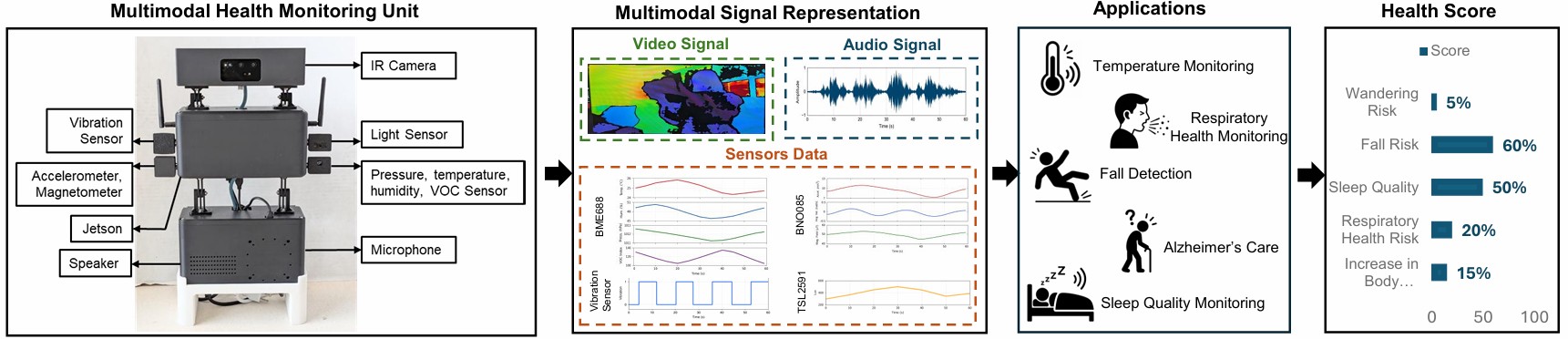
Figure. The PLOT v2 sensing-to-wellness pipeline integrates multimodal home signals (visual, acoustic, ambient, and physiological) into local edge-AI inference and clinician-facing summaries, with all raw streams remaining on the residence.
In the home, this stack supports concrete, valuable things. It can recognize a possible fall and confirm it through multimodal agreement before alerting anyone. It can flag a gradual change in gait or sleep that warrants a clinical conversation. It can offer gentle prompts for hydration, medication, or a brief walking loop without intruding. It can adapt environmental controls to inferred comfort state and step back when the resident requests it. For people living with mobility constraints, cognitive change, post-rehabilitation recovery, including Veterans returning home from clinical settings, or simply the everyday wear of a demanding life, these capabilities create real margin.
The same capabilities, in a different room
The technology itself does not care where it is deployed. The same multimodal sensing that supports a Veteran returning from rehabilitation can also tell a workplace whether an employee has been at their desk, how often they shifted posture, how steady their attention pattern was, how soon they responded to a prompt, and whether their physiological signals looked engaged. The same pose detection and conversational AI that helps an older adult re-engage with a morning routine can also tell a school whether a student looked away from a screen, looked tired, or paused too long.
In other words, capabilities developed for human-supportive home wellness can, with very little technical change, become capabilities for human-performance surveillance. The same software that recognizes a fall can recognize a slouch. The same audio model that detects a cough can detect a sigh. The same edge AI assistant that gently nudges a hydration break can issue a productivity reminder, an attention reminder, or a presence reminder. The infrastructure is identical; only the interpretation layer changes.
The question that needs an answer
This is where the ethics conversation needs to live. How do we address the growing expectation for constant performance, efficiency, and availability? How do we make sure these technologies support humans while still protecting privacy, personal space, time alone, the need to decompress, and the natural limits of being human?
The conversation about AI ethics often anchors on whether AI is becoming more human-like. Equally important, and less examined, is whether humans are being asked to become more machine-like. Once an environment continuously measures performance, those measurements quietly become standards. A person can begin to feel evaluated against patterns they did not consent to and do not necessarily endorse. The risk is not science fiction; it is gradual cultural drift, where every space (home, work, school, public) eventually inherits the same expectation of always being on.
A working set of commitments
Translational science has an opportunity here, because the same disciplines building these capabilities can shape how they are used. A few practical commitments matter:
- Context locks. Capabilities developed and approved for clinical or wellness use should be technically and contractually locked to those contexts, not silently re-purposed for performance monitoring.
- The right to be unobserved. Every system should offer a frictionless pause for the person in the environment, without requiring a justification.
- Asymmetric thresholds. High sensitivity to true safety events (falls, prolonged immobility, hazardous exposures) should not be matched by high sensitivity to lifestyle or productivity variance.
- Locally processed, locally stored by default. Raw streams should not leave the environment; de-identified summary measures should travel only with informed consent and a clinical or wellness purpose.
- Workforce readiness. Clinicians, care teams, supervisors, educators, and community workers who receive AI-generated summaries need training in proportion and interpretation, not only in dashboards.
Closing
AI-enabled wellness technology will expand. It should. Its benefits for individuals navigating rehabilitation, aging, caregiving, working, and learning are concrete and growing. The ethical task is to be deliberate about the shape of the relationship between people and the technology, especially as the same capabilities migrate from the residence into the workplace, the classroom, and every other space where humans are expected to perform. The goal of intelligent environments should not be a more efficient human. The goal should be a more supported one, with privacy, with rest, with autonomy, and with the freedom to remain fully human.
PLOT is a 25-acre living-lab initiative at the KSU Field Station, integrating intelligence across the residential PLOT House, outdoor environments, agriculture, infrastructure, and community-based research spaces. Its work focuses on home wellness, intelligent environments, sensing, robotics, assistive technology, environmental monitoring, precision agriculture, logistics, and human-centered AI. More information can be found at plotinnovation.com, and visits are welcome at the PLOT House, KSU Field Station, 1881 Hickory Grove Rd NW, Acworth, GA 30102.
Author

— by Razvan Cristian Voicu, PhD, Assistant Professor of Robotics and Mechatronics Engineering, Kennesaw State University; Lead, Prototype Living of Tomorrow (PLOT) Research Initiative, 6/2026
Continue the conversation! Please email us your comments to post on this blog. Enter the blog post # in your email Subject.